

Article by Wayne Gillam / Photos by Ryan Hoover
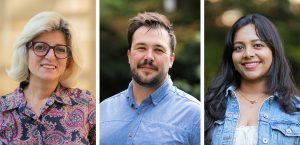
Students in the UW ECE Professional Master’s Program, including (from left to right) Bita Massoudi, Jayce Gaddis, and Devika Nair, are learning how to embed advanced AI capabilities into resource-constrained electronics. In the PMP course Deep Learning for Embedded Real Time Intelligence they are taught how to build and deploy AI models that use deep learning in Internet of Things and mobile edge devices.
Most Americans today live their lives immersed in technology. Mobile devices, such as smartphones, tablets, and laptops, are common platforms for working, playing, and staying connected with the world around us. Smart televisions, thermostats, and home appliances enabled by the Internet of Things (IoT) make life at home more comfortable and entertaining. And wearable technologies, such as smart watches and rings, help keep us informed about our health and well-being.
Many of these devices rely on machine learning and artificial intelligence (AI) to perform tasks such as recognizing images, understanding speech, and analyzing large amounts of data. And increasingly, these capabilities are powered by deep learning, a subset of machine learning that uses multilayered neural networks to identify complex patterns in data.
This creates a challenge for engineers. As AI becomes ever more integrated into everyday devices, there is a need to develop systems that incorporate deep learning but can still operate efficiently at the network edge, processing data locally on devices that often have limited computing resources, memory, power, and internet connectivity.
Now, students in UW ECE’s Professional Master’s Program are learning how to embed these advanced AI capabilities into resource-constrained electronics. In the course, Deep Learning for Embedded Real Time Intelligence, they learn how to build and deploy AI models that use deep learning in IoT and mobile edge devices.
This course is offered annually during spring quarter and receives generous support from industry partners. For example, during the 2026 spring quarter, students received a starter kit for their final projects from Wyze, a consumer technology company known for developing smart home devices and wireless cameras. Wyze also sent engineers to speak with students about how concepts taught in the course are applied in commercial products.
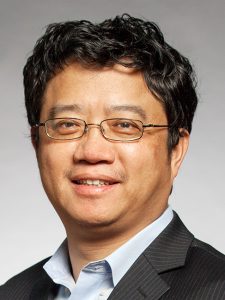
UW ECE Professor Richard Shi
The course is taught by UW ECE Professor Richard Shi, whose research and teaching focus on embedded systems, AI, machine learning, and hardware-software co-design.
“As AI becomes increasingly embedded in everyday technology, engineers need to understand both machine learning algorithms and the hardware systems that run them,” Shi said. “This course gives students hands-on experience designing, optimizing, and deploying AI solutions for real-world embedded devices, helping them develop skills that are highly relevant across today’s technology industry.”
In addition to being offered through the PMP curriculum, this course is also part of the PMP Certificate Program in Machine Learning and Deep Learning, which provides students with a deep dive into the field.
A common theme echoed throughout the course is that successful AI applications require far more than accurate models. Students must also consider hardware limitations, continuous performance, reliability, and user experience. So, through hands-on labs, industry engagement, and ambitious final projects, students in this course gain practical experience deploying AI in real-world embedded environments.
Three students who completed the course during the 2026 spring quarter shared their experiences and key takeaways:
Bita Massoudi and Devika Nair

PMP student Bita Massoudi demonstrates RespiraEdge, a real-time edge AI system for multimodal respiratory distress monitoring that can run on a laptop.
Bita Massoudi is a part-time PMP student who holds a doctoral degree in neuroscience. She has an extensive background in technology development and healthcare, having worked for organizations such as Microsoft and Seattle Children’s Hospital. She also runs her own consulting business. In the PMP, Massoudi is focusing on machine learning and deep learning and anticipates graduating at the end of the 2027 spring quarter.
Devika Nair is a full-time PMP student, who took a break from an established career as a firmware engineer for SanDisk to attend the program. She has in-depth experience working with embedded systems. In the PMP, she is focused on broadening her skillset and integrating her knowledge of real-time embedded systems with machine learning. She also plans to graduate at the end of the 2027 spring quarter.
Massoudi and Nair worked together on their final project in the course, RespiraEdge, a real-time edge AI system for multimodal respiratory distress monitoring.
Why were you interested in this course?
Massoudi: My background is in neuroscience, and I also spent several years in technology development and consulting. I’m especially interested in how AI can be applied to healthcare. But I realized a couple of years ago that there was a gap in my knowledge, especially with how quickly AI and machine learning were developing. That’s what brought me back to school.
I initially was in the Applied Cybersecurity Engineering Certificate Program, and my first course was in TinyML. Once I took that course, I realized that the subject was really interesting to me, and so I switched to the master’s degree program.
The TinyML course was highly hands-on. We learned how to build a complete machine learning system for very small, resource-constrained devices. And for the final project, I built an object detection system using a camera. So, when I saw this course, I was interested because it approached embedded AI from a broader deep learning and real-time system perspective. We went deeper into different neural network architectures, and also into questions of efficiency, such as quantization and latency, memory, and how deep computation can be optimized for different types of hardware.
So, for me, the two courses were complementary. I was able to build on what I had learned in the TinyML course and apply it to very different and more complex applications, and specifically to our final project, RespiraEdge.
“I’d like to combine my background in neuroscience with what I’ve been learning in AI and engineering and work on problems where this technology can have a meaningful, real-world impact.” — Bita Massoudi, PMP student
Nair: I was interested in this course because it was one where I felt I could connect my existing background in embedded systems with something I hadn’t worked with as deeply, which was machine learning. One of the things I appreciated most about the course was its hands-on nature. We had labs where we could implement and experiment with concepts, we could write reports, and we were able to see how things behaved, rather than just learning theory.
I would say one of the best things about the course I really want to highlight is that we often heard from guest speakers. We also got the opportunity to visit Wyze, so we could see how some of the ideas we discussed in the course were being applied beyond the classroom.
So, for me, it was the combination of machine learning, embedded systems, and the hands-on practical aspect that really made this course stand out.
What was it like to learn from Professor Shi?
Massoudi: I really enjoyed Professor Shi’s teaching style. He’s hands-on. He would teach the concepts in class, but then we had to apply them and build something that worked. So, it wasn’t just theoretical. He often brought in guest speakers, and he gave us opportunities for site visits, which I really liked because it connected what we were learning in the classroom with how these technologies are being used in industry. That practical side of the course was valuable to me.
Nair: I think the best part of Professor Shi’s course was his energy and enthusiasm throughout the lecture. What really stood out to me is how he emphasized that we needed to get practical experience, and he made sure the course was hands-on. We weren’t just learning concepts from PowerPoints or lectures, we were implementing these concepts through all of the assignments, which were labs. I think Professor Shi provided a very good balance between understanding the fundamentals and actually getting to experiment and build things. And I think that is what made the course so engaging.
Tell me about your final project, RespiraEdge.
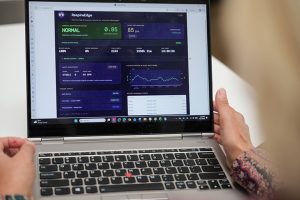
A closeup view of the RespiraEdge interactive dashboard, which presents information in an easy-to-understand, visual format.
Massoudi: RespiraEdge started with a very simple question: Can we listen to someone’s breathing and use AI to recognize when their breathing pattern becomes abnormal? With my background in neuroscience and interest in healthcare, I was drawn to the idea of whether something as basic as breathing could provide useful information about a person’s condition.
The whole idea is that changes in breathing could be recognized early, and perhaps an AI system could help bring attention to these changes sooner. So, we developed RespiraEdge as a real-time respiratory monitoring system. It listens to breathing sounds and uses deep learning models to determine whether the respiratory pattern appears normal or abnormal.
As the project developed, we wanted the system to look at more than just one prediction, “normal or abnormal.” We added continuous monitoring, heart-rate information from a Bluetooth sensor, and a rule-based intelligent agent that combines respiratory classifications, heart rate, prediction confidence, and trends over time to indicate whether the person appears stable, should continue to be monitored, or may need further attention. We also developed an interactive dashboard that runs locally, so all that information can be presented in an easy-to-understand, visual format.
One of the things that I really liked about this whole system is that everything is processed locally. It doesn’t need to continuously send someone’s respiratory data, that personal information, to the cloud. And the prototype uses relatively inexpensive consumer hardware. It used my computer’s microphone and a heart rate monitor that cost roughly $20.
So, what started as a normal versus abnormal breathing classifier evolved into a complete, real-time monitoring system, which was really cool to see.
“RespiraEdge brought everything together for me. I started out thinking primarily about neural networks, and by the end of the project, I was thinking about the entire system, from the microphone, all the way to what the user sees on the dashboard.”
— Devika Nair, PMP student
Nair: RespiraEdge is a device that can continuously listen to a person’s breathing through a microphone, and it can monitor their heart rate. The breathing audio is processed locally and transformed into data that our machine learning model can analyze.
In our case, we used an AI model that classified the respiratory activity as normal or abnormal. We then added the ability to stream the user’s heart rate over Bluetooth. So, we are not relying only on the breathing sound. The system combined those signals, and it displayed a risk state on a live dashboard. So, the main idea of our device was that everything happens locally. We don’t need to send the person’s audio to the cloud.
What I found particularly interesting about this project was that we weren’t just building a classifier, we were trying to make the device behave like a real, continuously running monitoring system. So, we had to deal with things like background noise, false alarms, and we had to make sure the system didn’t constantly switch between states.
Overall, what did you learn from the course?
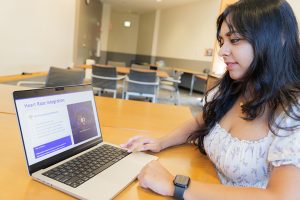
PMP student Devika Nair explains how RespiraEdge can incorporate heart-rate information from a Bluetooth sensor.
Massoudi: The biggest thing I learned was that developing a good AI model is only part of building a real-time intelligent system. You also have to think about computational efficiency, latency, memory, and the hardware. And then when you deploy the device, you have to think about sensors, data, noise, confidence, and reliability through the entire pipeline.
RespiraEdge brought everything together for me. I started out thinking primarily about neural networks, and by the end of the project, I was thinking about the entire system, from the microphone, all the way to what the user sees on the dashboard.
Nair: For me, this course was about the integration of machine learning and embedded systems. Coming from a firmware and embedded systems background, I was already used to thinking about reliability, real-time behavior, and edge cases. But I think this course really helped me see how important those same considerations are when you are building a machine learning system.
Throughout the labs, and especially when working on RespiraEdge, I learned that you can have a model that performs well on your test data, but once you put it into a real environment, you have to think about so many factors, such as noise, data differences, false alarms, and how the system behaves continuously. So, the course changed my perspective from, “Does the model work?” to “Does the whole system in its entirety work reliably?”
How will you use this knowledge going forward?
Massoudi: Going forward, I’d like to continue working at the intersection of AI, engineering, and healthcare. With a background in neuroscience, coming back to school gave me an opportunity to build the machine learning and engineering side of my knowledge. This course, in particular, added another piece to that by teaching me to think beyond just the AI model and more about how you build and deploy a real-time, intelligent system. I’d like to combine my background in neuroscience with what I’ve been learning in AI and engineering and work on problems where this technology can have a meaningful, real-world impact.
Nair: For me, because my background has always been in the same domain, embedded systems, this course has given me confidence and hands-on experience with machine learning as well. I now have a better understanding of how a machine learning model can fit into an embedded real-time system.
In my career, I see myself using these skills, especially at the intersection of embedded systems, firmware, and intelligent systems. So, even if I am not personally developing the machine learning model myself, understanding how the model works, what data it needs, and what it takes to deploy in a real system will help me work more effectively with teams who develop machine learning and AI systems.
Jayce Gaddis
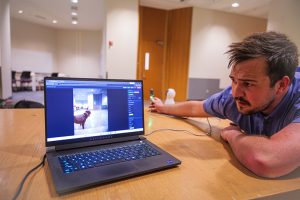
PMP student Jayce Gaddis demonstrates Dog SAURON, a smart, computer-vision-guided laser toy, created to keep his high-energy dog engaged and active.
Jayce Gaddis is a part-time PMP student who works at Amazon as a system development engineer. He is part of Amazon Leo, formerly known as Project Kuiper, the company’s low-Earth-orbit satellite internet initiative designed to provide broadband connectivity to underserved communities around the world.
Gaddis specializes in signal processing, analog/mixed-signal hardware design, register-transfer level (RTL) development, and firmware development. He says he is most passionate about developing cutting-edge technologies that make a difference globally. He anticipates graduating at the end of the 2028 spring quarter.
His final course project was a smart, computer-vision-guided laser toy, which he created to keep his high-energy dog engaged and active. He named the project, “Dog SAURON (Smart Autonomous Unit for Redirecting Overstimulated Nonsense),” a tongue-in-cheek title that reflects both the toy’s purpose and outer shell design, which is built to look like the tower of Barad-dûr in Tolkien’s classic Lord of the Rings books.
Why were you interested in this course?
Gaddis: Honestly, it sounded really fun. I didn’t know a lot about machine learning or any of these processing algorithms at the time, so it piqued my interest. I saw that it would be an open-ended course where I could work on fun projects that were exciting to me.
What was it like to learn from Professor Shi?
Gaddis: He was a very helpful professor. He had really good insights and focused a lot more on industry, which was also good. It was a different change of pace from other courses that I’ve taken in the program. For example, he brought in some engineers from Wyze to speak a few times because they were applying the same things in their work that we were learning in class. They were able to teach us how they were applying the concepts we were learning, and that was really good.
Tell me about your final project, Dog SAURON.

A photo illustration showing Gaddis’s vision for what Dog SAURON could look like after the plastic toy surround is built and a few more features are added. Image provided by Jayce Gaddis.
Gaddis: Sure, Dog SAURON is a smart, computer-vision-guided laser toy that I made to keep my dog entertained. I have a Border Collie lab mix, so he has all of the energy and all of the silliness that breed is known for. I had found a laser toy for him on Amazon, and it randomly points a laser around the room for a pet to chase. However, when you have a really smart dog, like a Border Collie, they pick up on the pattern and get bored. So, I got inspired to make something a little bit smarter.
In this course, we were learning about how to use machine learning to find where things are in a frame. And we were also learning about how to classify things, for example, how to tell where the floor is and where the walls are. I saw it as the perfect application to keep my dog engaged. It was a really fun project to work on too.
So, I started developing, building my system on top of the laser toy. I used an Arduino fitted with a camera and shrunk the machine learning model to fit on this little Arduino. That was the most challenging part of the whole project. I tried to change and re-solder the part, but it was cheaply made, and it broke. I really need to make my own circuit board before the device will work 100 percent, but all the necessary algorithms are there.
And then, to move the laser pointer, I used a lot of what I learned from a previous course in control systems. I was able to make a control system loop to guide the laser pointer. I also trained the model to only shine the laser on the floor (rather than on the walls or elsewhere) as a safety feature.
Overall, what did you learn from the course?
Gaddis: I went into this course with only a cursory understanding of AI. I understood the math behind it, at a high level. But I did not know any of the fundamentals that we were taught in this course. Basically, I went in almost blind.
I ended up learning how to train and set up the AI and machine learning models. I also learned that there are different types of transformers to use in different circumstances, and some work better than others. There’s always tradeoffs in this work, so I learned all of that.
“In this course, we were learning about how to use machine learning to find where things are in a frame. And we were also learning about how to classify things, for example, how to tell where the floor is and where the walls are. I saw it as the perfect application to keep my dog engaged. It was a really fun project to work on too.” — Jayce Gaddis, PMP student
I also learned how to shrink an AI model down to fit into an embedded system. It’s one thing to run the model on your laptop computer, and a lot of the students were able to do that. It’s a whole other thing to try to shrink that AI model into a smaller, embedded system.
How will you use this knowledge going forward?
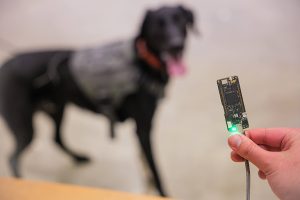
A closeup of the microcontroller inside of Dog SAURON. In the background, the furry, high-energy inspiration for this project.
Gaddis: In my current job, I don’t do a lot of programming, so I couldn’t see using this knowledge there. But I don’t plan to be in this role forever, and the course gave me a good understanding of other systems and other embedded technologies that I have to work with as a systems engineer, so it built up my strength in that area.
Also, I have to work with the embedded firmware and hardware teams in my current role. This course gave me a better understanding of what is happening when those teams are running these AI models. For example, with the array we are working on, you could use AI to figure out where to steer the antenna beam. So, this course provided me with enough understanding that I could work with them on that, provision appropriate resources, and provide them with the right type of processor for that purpose.
From a larger perspective, the Professional Master’s Program started contributing to my professional goals from the beginning. I moved into the role I have now right after starting in the PMP, and it helped me to adapt really quickly. For example, I took a course in the fundamentals of Maxwell’s equations, and after every class, without fail, I was applying it to my work the next day. I’d be debugging an antenna or an array, and I was able to apply what I learned the day before about reflections, impedance matching, and everything else. The PMP is also flexible enough to allow me to keep working and supporting my family while I’m going to school at night. The program has just been awesome in these ways.
Learn more about the Deep Learning for Embedded Real Time Intelligence course and the UW ECE Professional Master’s Program on the UW ECE website.