

By Wayne Gillam / UW ECE News
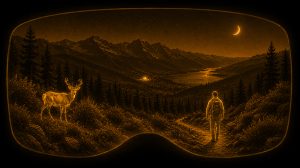
Night vision goggles are indispensable tools in a wide range of applications, including outdoor recreation and wildlife conservation, but even state-of-the art goggles are surprisingly bulky, heavy, and power hungry. Now, in a collaboration with the University of Illinois at Urbana-Champaign and Yale University, a research team led by UW ECE and Physics Professor Mo Li has developed technology that could make night vision goggles dramatically thinner, lighter, and much more energy efficient — helping to transform bulky goggles into sleek, form-fitting eyeglasses. Shown above: An illustration of what a nighttime landscape could look like, if rendered with the type of night vision system Li’s team is developing. Illustration provided by Professor Li.
For many people, their only experience with night vision goggles is seeing them worn by soldiers in movies and television shows. But these devices play critical roles far beyond the screen.
Night vision goggles help pilots navigate after dark, assist search-and-rescue teams in emergencies, and enable military personnel to operate in low-light conditions. The technology has become indispensable across aviation, search-and-rescue, military, law enforcement, industrial inspection, wildlife research, and emergency-response applications.
But unlike the fake props we see in the movies, real, state-of-the-art night vision goggles are surprisingly bulky, heavy, and power hungry, despite decades of engineering development.
So heavy, in fact, that wearing night vision goggles for extended periods can place significant strain on the user’s neck. These heavy goggles can also cause eye strain, and because of the high voltage required to run them, battery life is limited.
But now, in a collaboration with the University of Illinois at Urbana-Champaign and Yale University, a research team led by UW ECE and Physics Professor Mo Li has developed technology that could make night vision goggles dramatically thinner, lighter, and much more energy efficient — helping to transform bulky goggles into sleek, form-fitting eyeglasses. The team described their recent breakthrough in a paper published in the prestigious journal Nature Photonics.
“In the future, I think it is conceivable that an eyeglass form factor could provide infrared night vision. For example, there has been a lot of research on building augmented reality into smart glasses. So someday, potentially, these glasses could have infrared night vision built into them. That’s within the realm of possibility.” — UW ECE and Physics Professor Mo Li
“Current night vision systems use a high-voltage photomultiplier in a vacuum tube that is a few inches long,” Li said. “We’re replacing that heavy, bulky tube with a low-voltage, solid-state device that is only a few micrometers thick.”
The transition is similar to the shift from bulky cathode-ray-tube televisions to the thin, flat-screen displays used today. Li’s team has developed a research prototype that replaces photocathode tubes in night vision goggles with solid-state technology. This new night vision system is well over 10,000 times thinner than the photocathode tubes currently on the market, shrinking a component normally measured in inches to one measured in micrometers. The prototype also uses a remarkably small amount of voltage — less than what two AA batteries provide — to make the low-level infrared light it detects glow more than 17,000 times brighter.
The team’s prototype demonstrates that solid-state devices may soon be capable of matching performance traditionally achieved only by bulky vacuum-tube night vision systems.
Converting nightglow into night vision
At night, Earth’s atmosphere continuously emits infrared radiation, producing a phenomenon known as “nightglow” or “airglow.” Infrared light is invisible to the naked eye, but night vision goggles can capture these light waves and convert them into visible light.
Li’s research team chose to focus on the short-wave, or “near-infrared” part of the spectrum, so named because these infrared waves are closest to the narrow band of the spectrum that humans can see.
“Night vision goggles cannot see anything if there’s absolutely no light,” Li said. “But even on a pitch-black night, it’s not completely dark. That is because even if there is no visible light, the sky is still bright in the infrared band.”
By replacing bulky photocathode tubes with a thin, lightweight solid-state device in their research prototype, Li and his team have brought the technical foundation for turning infrared night vision goggles into eyeglasses a significant step forward.
Building a solid-state solution

Professor Mo Li holds a joint appointment in UW ECE and the UW Department of Physics. He is also a member of the Institute for Nano-Engineered Systems and QuantumX at the UW. Photo by Ryan Hoover / UW ECE
But how did Li’s research team accomplish this? First, a little background.
Most night vision goggles use photocathode tubes (also known as “photomultipliers” or “multiplier tubes”) to absorb infrared light. When infrared photons hit photoemissive materials in the multiplier tubes, electrons are emitted, and a high voltage is applied (measured in hundreds or even thousands of volts) to accelerate the electrons to high speeds. These electrons strike additional photoemissive layers, triggering a cascade that generates exponentially more electrons. This is called a “multiplication effect,” and it greatly amplifies the electrical signal. After this electrical amplification, the final batch of electrons hit a fluorescent screen in the goggles, which forms an image that the user can see.
This entire process is called “direct view” or “infrared night vision,” because there is a one-to-one relationship between the infrared photons received and the amplified light that is output for the user to see. Unlike thermal imaging, which detects long-wave thermal radiation (heat) and renders fuzzy temperature silhouettes, infrared night vision amplifies short-wave infrared light and renders realistic features, textures, and details. It also requires fewer mechanical parts to render a visible image than thermal imagers do, making it less expensive and lighter weight.
“This work demonstrates that innovation can arise from harnessing a well-known phenomenon for previously unexplored applications. Recognizing its potential in a new context can translate that insight into a practical technology.”
— Professor Fengnian Xia, Yale University
There have been other attempts to build a solid-state replacement for photomultipliers in infrared night vision goggles; however, previous efforts have struggled to meet the desired targets for infrared sensitivity, amplification, and low voltage.
To address these challenges, Li and his research team took a unique approach when building their solid-state device. They first took advantage of a physical phenomenon known in semiconductor physics as the “avalanche effect” — a process where an electric field causes a rapid, cascading multiplication of electric current through a semiconductor.
Using the avalanche effect in a solid-state photomultiplier has been tried before; however, what Li’s team did differently was to build this effect into the base of the device’s phototransistor, creating an “avalanche phototransistor.” This greatly reduced the night vision system’s power requirements, lowering operating voltage from more than 200 volts for multiplier tubes and roughly 15 volts for previous solid-state approaches to less than 1.6 volts, while still producing enormous electrical amplification.
“The materials used to detect infrared light and emit visible light have widely different properties, so we had to deposit them on separate substrates. An exciting next challenge will be to integrate avalanche phototransistors with green micro-LEDs on a single chip.”
— Professor Lee, University of Illinois at Urbana-Champaign
“Together with our Yale collaborators, we found that the device we designed has a surprisingly high amplification effect, beyond what we originally designed or expected,” Li said. “It’s the combination of the avalanche effect and the transistor amplification that provides ultra-high amplification.”
They then engineered a micro-light-emitting diode (LED) that could be activated by a very low electrical current to generate an amber-colored, visible light. This micro-LED was specially designed by Li’s collaborators at the University of Illinois to be “ultra-low threshold” because only a small amount of electrical current is needed to trigger it.
The breakthrough came when the team combined their avalanche phototransistor and the ultra-low threshold micro-LED. This unique combination enabled them to engineer an infrared night vision system that could produce powerful electrical and light amplification while remaining thin, lightweight, and energy efficient.
Looking ahead
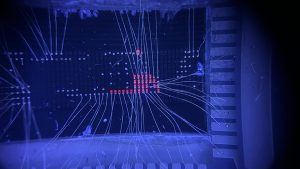
A closeup of micro-LEDs that were specially designed by Li’s collaborators at the University of Illinois. These ultra-low threshold micro-LEDs only require a small amount of electrical current to activate and are a key component of the night vision system the team is developing. Photo provided by Professor Li.
This project brought together faculty and student researchers at the UW, the University of Illinois, and Yale University. Li, along with professors Minjoo Larry Lee at the University of Illinois and Fengnian Xia at Yale University, were senior authors of the Nature Photonics paper, and UW ECE alumnus Seokhyeong Lee (Ph.D. ‘22), who was a research assistant in Li’s lab when this work took place, was a lead author. UW ECE graduate students Haoqin Deng and Zhiyue Han, and UW ECE alumnus I-Tung Chen (Ph.D. ‘25) were all co-authors. Support for microchip fabrication was provided by the Washington Nanofabrication Facility.
“This work demonstrates that innovation can arise from harnessing a well-known phenomenon for previously unexplored applications,” Xia said. “Recognizing its potential in a new context can translate that insight into a practical technology.”
Next steps for the research team include using industrial manufacturing processes to scale up their prototype from its current 4X4 pixel array to the millions of pixels needed for a wide field of view. Li said there is also still room to improve light sensitivity and the amplification ability of their device. Another goal will be to change the amber light their prototype is currently emitting to green. Humans can detect more shades of green than any other color, which is why green is the most-used color for night vision technologies on the market today.
“The materials used to detect infrared light and emit visible light have widely different properties, so we had to deposit them on separate substrates,” Lee said. “An exciting next challenge will be to integrate avalanche phototransistors with green micro-LEDs on a single chip.”
Li noted that there also could be other applications for this technology, such as medical imaging and robotics. But for now, the team remains focused on a goal that once seemed unlikely: transforming bulky night vision goggles into lightweight eyeglasses.
“In the future, I think it is conceivable that an eyeglass form factor could provide infrared night vision,” Li said. “For example, there has been a lot of research on building augmented reality into smart glasses. So someday, potentially, these glasses could have infrared night vision built into them. That’s within the realm of possibility.”
This research was funded by the U.S. Defense Advanced Research Projects Agency, or DARPA, and its ENVision program, which aims to evolve heavy night vision goggles into a lightweight eyeglass form factor. Oversight was provided by UW ECE and Physics Professor Arka Majumdar, who is the program’s principal investigator at the UW. To learn more about this work, read the research team’s paper in Nature Photonics.